User query
"I want to hire a freelancer to help with my store, but can they cause damage if I give them access to my theme? I also need help with SEO because I'm not getting sales." — Shopify Community forum thread
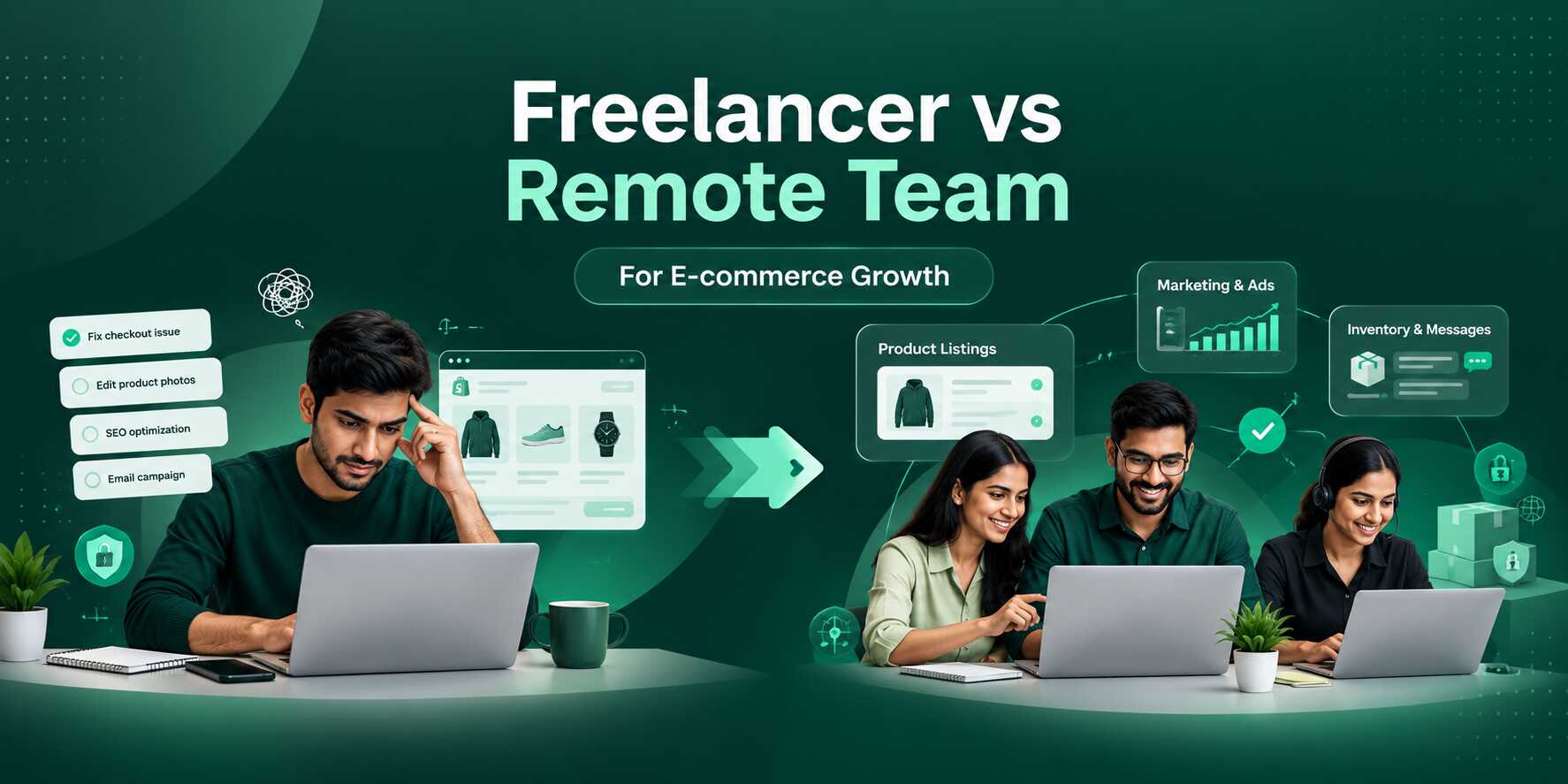
That one post packs in the two questions I hear most. Can I let someone into my store without losing sleep? And who's going to turn this thing into actual sales? Both end up at the same decision: bring in an e-commerce freelancer, or set up a dedicated remote team.
Here's where I land. A freelancer gets you moving faster and costs less up front. A team costs more per month but holds up better when the store gets busy. Still, I wouldn't ask which is better — ask your store what it needs right now, because that answer keeps shifting every few months. This guide runs through costs, speed, risk, and communication, with notes tailored for the USA, UK, UAE, Canada, and Australia.
What an e-commerce freelancer does well
A freelancer is one person with a handful of clients, and you're one of them. You pay for a task or some hours. When it's finished, you stop paying, or you book them again.
Jobs that suit a freelancer
They do best on work that has a clear start and finish:
- Fixing a broken checkout. A good Shopify developer can sometimes sort this in a day, and you pay for that day only.
- Editing a pile of product photos.
- Getting a Google Shopping feed approved after it keeps getting rejected.
- Rewriting fifty product descriptions before a sale.
- Building a Klaviyo email flow, or setting up your first listings on Amazon.ae, when you need a rare skill for a few weeks.
Where a freelancer lets you down
You're hiring one person, not a system, and that's the weak spot.
- Illness, a bigger client, or a quiet disappearance can freeze your work.
- Backup is rare. An agency can swap someone in, as one guide on custom store builds points out.
- Handover hurts. The next person might spend an awful lot of hours trying to figure out what the last one built, and that lost time never shows up on the budget.
What a dedicated remote team brings
Picture full-time people who work for you and nobody else. They join your stand-ups, learn your catalogue, and use your tools, the way in-house staff would. A partner company usually deals with hiring, payroll, and HR — the bit most owners hate.
Coverage you can't get from one person
"E-commerce marketing" sounds like one job. It's really ads, SEO, email, listings, customer messages, and reporting. Ask one freelancer to cover all of that, and something gets dropped, usually the catalogue. A small team shares it out:
- One person looks after listings.
- Another runs the paid ads.
- A third keeps an eye on stock.
Staying power
If someone quits, the others carry on while the provider finds a replacement. Whatever the team has learned about your store stays put.
Freelancer vs dedicated team: cost comparison across 5 markets
Hourly rates seem cheap until you count the hours. One cost breakdown for Shopify stores puts freelance developers at about $50 to $150 an hour. Twenty hours a month at $100 is around $2,000. That's fine for occasional work, and painful if you need someone every day.
A dedicated offshore team charges one monthly fee per person, full-time. Hiring locally brings costs people forget about:
- USA: recruiter fees, benefits, payroll taxes.
- UK: employer National Insurance, pensions, holiday pay.
- UAE: visas, gratuity, end-of-service payments.
- Canada: CPP, EI, and vacation accrual.
- Australia: superannuation, leave loading, and the risk of redundancy pay.
A managed provider takes most of this on. The Remote Staff says clients save up to 70% against the fully loaded cost of the same local role. Notice the "up to." Ask for a quote on the exact role you need.
Not sure which model fits?
Tell us the e-commerce work on your plate. We'll say honestly whether a freelancer or a dedicated team fits — and send pre-vetted profiles in 48 hours.
Quality, communication, and risk
What the day to day feels like
Talking to a freelancer is easy. One person, one thread. That works while the job is small. It stops working when they reply in ten minutes on Tuesday, then go silent on the Friday of your Black Friday push.
A team usually comes with an account manager, plus daily reports and monthly reviews. Setting it up takes more effort. Once it's running, you don't spend your mornings asking for updates.
Access and security
Back to the forum question. Giving anyone access to your store is a risk, and worrying about it is sensible. A few habits cut that risk down:
- Limit what collaborators can see. Shopify lets you block theme access entirely.
- Ask for references before you share anything sensitive.
- Keep your own copy of key files and logins.
A dedicated team works under employment contracts, with monthly compliance checks. That doesn't remove the risk. It does make it a different kind of risk from handing your logins to someone you found on a marketplace last week.
Local details that trip people up
- UK: VAT is 20%, and it changes how you price and build product feeds.
- Australia: GST is 10%, with the same effect on pricing and feeds.
- UAE: VAT is 5%. Noon and Amazon.ae matter, and listings in Arabic and English often help.
- Canada: many stores need English and French content, and GST/HST rules vary by province.
- USA: sales tax differs by state, so checkout setup is fussier than you'd guess.
How to choose the right e-commerce staffing model for your business stage
Go with an e-commerce freelancer if you've got:
- A single project with a clear end.
- Not much budget.
- An idea you'd like to test before you commit.
Go with a dedicated remote team if:
- You need daily work across several skills.
- Your headcount will rise and fall with sales.
- You're juggling three or four vendors, and it's wearing you out.
- You'd rather not build an HR function.
Lots of owners end up using both. They try an idea with a freelancer, then move to a team when the work becomes regular.
Where The Remote Staff fits
The Remote Staff builds and manages dedicated offshore teams for companies in the UAE, USA, UK, Canada, and Australia. They sort out the recruitment, payroll, compliance, and performance management — you just tell the team what to get done.
Their e-commerce services cover roles such as:
- E-commerce Manager
- Amazon and Marketplace Specialist
- Shopify Developer
- Catalogue and Listings Executive
You can begin with a single specialist or jump straight to a managed team.
One client story shows the range. GGS, a UAE business, hired three e-commerce specialists in December. The team now has 23 people handling marketplace operations, paid growth, catalogue management, design, and finance support.
Freelancer vs dedicated team vs The Remote Staff
| Factor | E-commerce Freelancer | Typical Local Hire | The Remote Staff (Dedicated Team) |
|---|---|---|---|
| Time to start | Days, if you find a good one | Weeks to months | Profiles in 48 hours; live in 1 to 2 weeks |
| Cost model | Hourly or per project | Salary plus taxes and benefits | One monthly fee per person |
| Skills covered | One or two | One per hire | Several roles under one partner |
| Backup if someone leaves | Rare | You start over | Free replacement, handled by the provider |
| Payroll and compliance | Their problem | Your problem | Handled and audited monthly |
| Management load | Low for small jobs | High | Account manager, daily reports, monthly reviews |
| Best for | One-off projects | Core in-house roles | Ongoing, growing operations |
Why choose The Remote Staff
- Fast start: pre-vetted profiles arrive within 48 hours. Interviews cost nothing, and you only pay when you hire.
- Real vetting: candidates go through AI matching, recruiter checks, and a proctored assessment. You can also ask for a paid trial task.
- Less admin: contracts, payroll, gratuity, devices, and compliance are theirs to handle.
- People who are yours: staff work only for you, in your time zone, in your stand-ups.
- Room to start small: hire one specialist and add more later. Engagements run month to month with no setup fee.
- Free replacement if a hire isn't working.
Starting rates depend on region — for example, from $1,499 a month in the US, £799 in the UK, and A$2,499 in Australia. Role and seniority set the final price.
Frequently asked questions
Short jobs that end. A theme fix, a photo batch, a feed repair, or one campaign build. You pay for the work and nothing else.
Write a clear brief and a checklist for each deliverable. Keep your own copies of files and logins. Start with a small paid task before a big project, and only give the access the job needs.
Yes, and that's where teams earn their price. Add a marketplace specialist or an ads manager when demand grows. The Remote Staff's GGS client went from 3 people to 23.
Recent work on your platform, real references, and a clear scope. Ask about availability, their backup plan, and their tax knowledge for your market. Confirm who owns the files, and restrict store access.
A freelancer is a single contact. That's quick, but it hangs on one person's calendar. A dedicated team usually adds an account manager, daily reports, and regular reviews, so updates reach you without chasing.
For the long run, usually the team. It keeps store knowledge inside your business, covers more skills, and survives staff changes. Freelancers still earn their place on short projects next to it.
Conclusion
Choosing between an e-commerce freelancer and a dedicated remote team ultimately depends on your store's current needs, workload, and long-term goals. If you need help with a few specific tasks, a freelancer may be the right fit. However, if your business requires ongoing support with product listings, marketing, customer service, and daily operations, a dedicated remote team can provide the consistency and flexibility you need to grow. Understanding these differences will help you choose a staffing solution that aligns with your business objectives.
If you're ready to grow your e-commerce business, choosing the right staffing solution is the next step. Whether you need a freelancer for specific tasks or a dedicated remote team for ongoing operations, finding professionals who match your business goals can make all the difference. Contact best outsourcing company to discuss your hiring needs and explore the right support for your online store.
Build an e-commerce team that sticks
We'll find, employ, and manage dedicated specialists — marketplace, catalogue, Shopify, support — on one monthly invoice. Interviews are free.