What a real HR manager is asking right now
A poster on r/humanresources (around September 28, 2026) handles HR for roughly 140 people. The company already has a larger, older HRMS, but it leaves gaps. They want performance reviews and simple time cards for fewer than 30 staff, and they don't want payroll, leave or recruiting modules. Their complaint: "quite encompassing and offer more than we need."
When you're researching an HRMS, there's a decent chance your problem is small and resolvable. There are various instances of employee information in disparate systems. Approval for leave is done in various group chats and never reaches a formal record. Payroll processing takes an employee half a week every month and is despised by all. A good software solution addresses all this.
A different type of company shows up in your search with a different problem. They have a great HR system, but they don't have enough people. Various employees end up doing the work of multiple people and tracking it. A better solution for tracking employees doesn't alleviate the workload of the various employees covering all the HR functions.
So the right question isn't HRMS versus remote staffing. It's do you need a better process for the team you have, or do you need a better team?
What is HRMS and what does HRMS software actually do?
HRMS stands for Human Resource Management System — basically a central hub for your HR work, which used to be scattered all over multiple spreadsheets and even inboxes. Vendors vary, but you can generally expect:
- Employee records and important documents to be all in one place
- Attendance tracking and leave management
- Payslips and pay calculations — from the company's perspective
- Performance reviews and goal setting to flow smoothly
- Onboarding approvals and a bunch of other HR related workflows to be streamlined
- Reporting, and usually some level of automation to make the repetitive stuff less painful to deal with
But here's the thing — local rules are way more varied than people would imagine. You've got US teams dealing with PTO accruals and those I-9 forms that are always a bit of a pain to sort out, while in the UK it's statutory sick pay and holiday entitlement to get your head around. UAE employers then have to handle Wage Protection System salary files and all that end-of-service gratuity nonsense. Meanwhile, over in Canada, it's provincial vacation rules, while down in Australia you've got Single Touch Payroll and superannuation to crunch through. A good HRMS has all that figured out. But a bad one just lets you find out the hard way — often by getting yourself into some kind of trouble.
When does an HRMS make sense?
When the team is in place, but the administrative tasks are eating into the team's productive time. When performance reviews are done manually. If you have payroll errors, missing leave records, slow onboarding, no way to see who is in the office, final performance reviews done in Word and saved on a local drive. If all these reflect your situation, then buying an HRMS would be money well spent.
What is remote staffing and how does it work?
Remote staffing connects you with real people — support agents, developers, marketing pros, and administrative staff — who show up at your business but work from somewhere (anywhere?) else. They're part of your team, working for your company, and a staffing partner sorts out putting that team together, handling the day-to-day stuff — no installations to worry about. It's a team-building deal, not some fancy software package.
The partner usually handles the hiring, the office (or wherever), HR headaches, payroll, attendance and all the other nitty-gritty that goes with managing a team. You get to focus on what you do best: giving orders, handing out assignments, steering the ship, and keeping an eye on the work that gets sent back your way.
What problems does remote staffing solve?
It's the perfect fit when:
- You need more people than you have
- It's tough to find local talent, and you don't have the time to search far and wide
- You'd rather build a loyal, dedicated team rather than relying on freelancers who drop in and out
- Recruiting is eating your managers' time
- HR, payroll and attendance work keeps stacking up, and you don't want to build the workspace and infrastructure yourself
Not sure whether you need software or people?
Tell us what's actually slowing you down. We'll tell you straight whether a dedicated team would fix it — or whether an HRMS is the cheaper answer.
HRMS vs remote staffing: what's the real difference?
One is software and the other is a service. An HRMS helps you get your HR department in order and keep all those pesky employee details together. But remote staffing is more hands-on — it gets you the people you need, and also lends a hand with finding, managing and keeping them in the first place.
You can use an HRMS to pull all sorts of records together — attendance, leave, payroll tasks, performance reviews, onboarding, and all the reporting — and suddenly much less of your time is sucked up in drudge work and your HR people get a much clearer view of what's going on. Of course, this only works if you already have those employees on the payroll.
Remote staffing is not a replacement system. It's a way for you to build and run a remote team. The partner can take care of recruitment, workplace arrangements, HR administration, payroll and attendance, and you are in charge of what the team does all day long.
Here's how that shakes out against common needs:
- Managing the staff you already have? An HRMS does a good job of getting all the HR processes in one place and keeping records up to date.
- Struggling to find people to work for you? Hiring remote staff can bring in dedicated individuals — something an HRMS just can't do on its own.
- Is the hiring process where things are really bogging you down? Remote staffing runs the recruitment and the setup.
- Want HR admin off your plate? A staffing partner can own it day to day.
- Remote employees need somewhere to work? The partner provides the workplace and the infrastructure.
- Attendance and payroll slipping? An HRMS gives you tools. A staffing model does the work as part of the service.
- Tired of workforce admin getting in the way of projects? That's where remote staffing helps most.
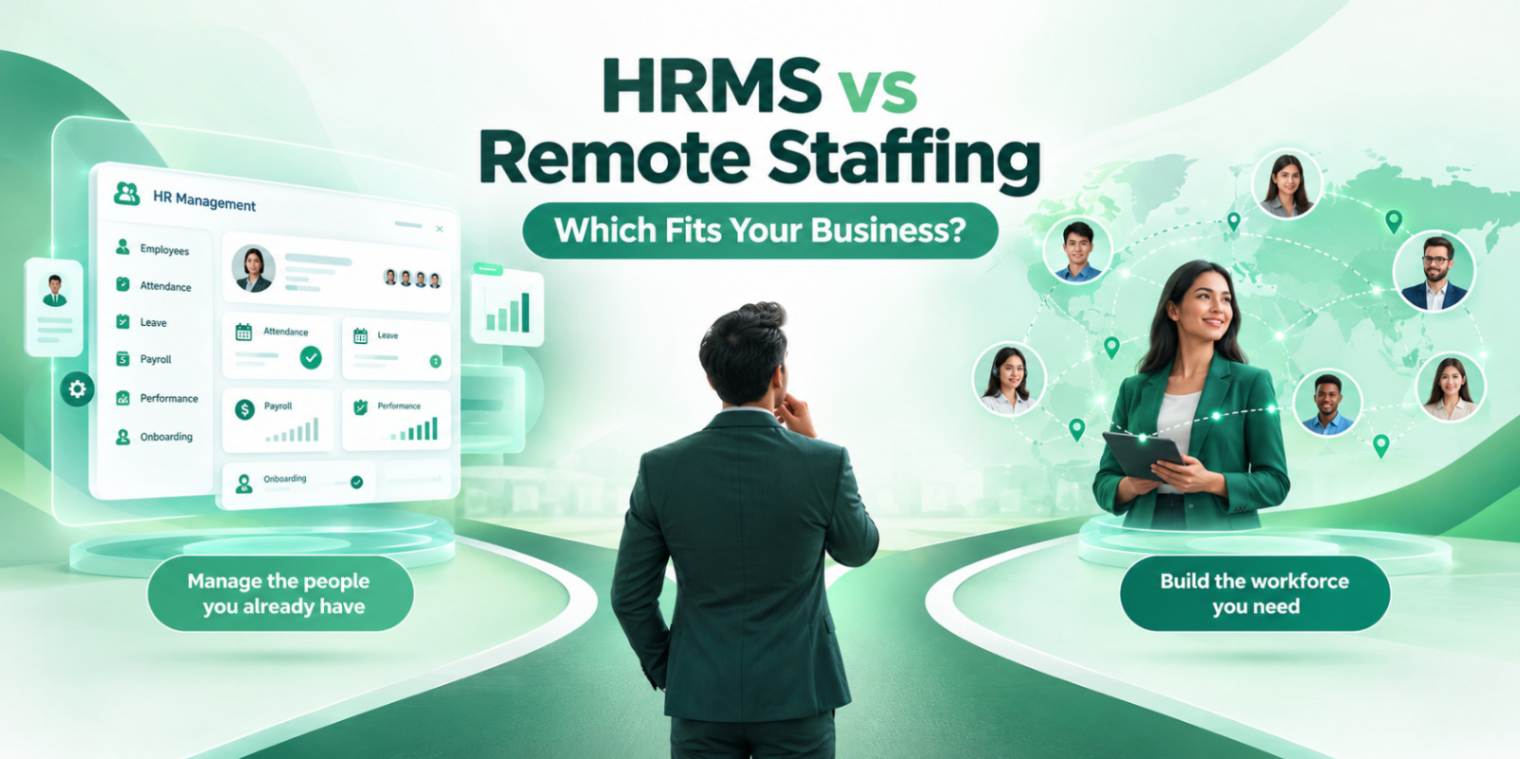
So an HRMS is useful for managing the people you already have on board. And remote staffing is there to help you build up the workforce you actually need. They're not competing with each other, either — lots of companies end up running an HRMS to keep track of their in-house staff and at the same time use a remote staffing partner to help with a specific dedicated team.
HRMS can manage employees, but it doesn't create your workforce
There's a gap that most HRMS solutions seem to overlook. They're great at managing people once you've got them on board. But as for actually creating your workforce... they can't quite manage that.
Think of a rapidly growing e-commerce company that suddenly needs to hire 5 customer support reps, 2 in-house developers, and 1 digital marketing whiz. An HRMS can handle the paperwork and tracking once these eight folks have actually joined the team. But what about before that? Who's going to find those candidates, bring them on, get them set up in an office (or remote workspace), handle time off, cut paychecks, and deal with all the administrative hassle of HR?
The software can take care of the last part of that equation. But everything leading up to it — finding the right people, making the hires, getting them set up — that all still falls squarely on your shoulders. Which is part of why remote staffing is a whole different ball game.
When remote staffing may be a better fit
Remote staffing is a better fit when what you need is more people, not a better HR system to try and manage them. It's where it tends to come in handy.
You're overwhelmed — more employees, not more paperwork
You can't just buy a new HR system to make up for the fact that your team is underworked. You need more people who can actually own the work.
You need help with hiring, and the rest comes with it
Hiring is an enormous job in itself — writing job descriptions, sourcing, screening, interviewing, chasing after people. A remote staffing partner does the legwork for you so all you have to do is choose from them and let them know what you need.
You want a workforce that stays around
Some work requires people who can stick around, learn how you do things and get better over time. Short-term freelancers just don't deliver in the same way. A dedicated team of remote workers can.
You need someone to handle the paperwork
Every employee hire brings with it a ton of paperwork — records, HR stuff, support, attendance, payroll. And someone has got to be the one to own all of it. A remote staffing partner can.
You want to outsource payroll and attendance problems
These things happen regularly and require accurate records. If you have a staffing arrangement in place, you can hand it over to them and forget about it.
You need a workspace for your remote team members
Remote workers still need a proper working environment, equipment, a decent internet connection and someone to sort out the tech when it breaks. The partner will handle that bit.
You need to scale without building an entire infrastructure
Every new employee adds more and more work in terms of recruiting, HR, payroll and the logistics of setting up a workplace. Remote staffing lets you grow without all that extra overhead.
You just want to focus on the work
The biggest advantage to remote staffing is that it lets you split the responsibilities, letting the partner handle all the workforce side of things and you focus on what actually moves the business forward.
Can remote staffing handle HR administration?
Yes, it can. Under our service model, the partner takes on all the supporting workforce responsibilities — hiring, workplace, HR admin, payroll, attendance, employee records and day to day operations. You just need to manage the team's work and your business goals.
And don't get this confused with a simple HR outsourcing service. What we offer includes the people, the hiring, the workplace, the HR, the payroll and the attendance as part of the deal.
Is remote staffing a better fit for your business?
If you've already got the people in place and just need to tidy up your HR processes, sticking with an HRMS is probably your best bet. But if you're the type of business that's really looking for a workforce — not just some fancy software to keep track of one — then a staffing model that takes care of the setup and the day-to-day administration is definitely worth a serious look.
That's exactly what The Remote Staff offers — the whole package, not just some HR software to try and make do with. Here's how the two options compare on the things that really matter to your business:
| Business requirement | HRMS | The Remote Staff |
|---|---|---|
| HR software | Yes | Not the core service |
| Employee management system | Yes | Workforce administration |
| Hiring / recruitment | Not the primary purpose | Yes |
| Dedicated employees | No | Yes |
| Workplace | No | Yes |
| HR administration | Software-supported | Managed |
| Payroll | Software / process support | Managed |
| Attendance | Tracking / management | Managed |
| Team building | No | Yes |
| Remote workforce | Helps manage employees | Provides and supports workforce |
| Workforce expansion | No | Yes |
| Client's primary role | Manage HR processes | Manage the actual work and business direction |
Need the workforce, not just the software?
Tell us the roles you're trying to fill and the hours you need covered. We'll send pre-vetted profiles in 48 hours — free to interview, no setup fee.
Why choose remote staffing for workforce expansion?
If you're the type of business that needs a workforce to take it to the next level, then a workforce partner like us gives you a bunch of good things:
- Dedicated employees instead of rotating freelancers
- A lighter hiring load for your managers
- No separate workplace to set up
- Less HR administration for your in-house staff
- Payroll and attendance handled for you
- An easier path to adding people later
- More management time spent on real work
It's a workforce partner — not just some alternative to HR software.
Frequently asked questions
Not every time. If you're looking to grow your team and need someone to keep on top of the admin for them, then remote staffing is your winner. But if you've already got a team in place and HR processes are a bit of a mess, then an HRMS is the one to go for — they're just different problems to solve.
An HRMS is basically software that helps with HR and employee data. Remote staffing on the other hand, supplies not just the team members, but all the extra things that come with hiring, setting up a workplace, paying their salaries, dealing with time off and handling all the other HR admin stuff. You manage the team as a whole with one, but you build and run the team with the other.
Yes, it can. The partner takes care of all the employee admin, so you can get on with directing the work, assigning tasks, telling them what to prioritise and reviewing their output.
When the problem isn't so much with the process as with finding good people in the first place. If you still need to sort out things like hiring, setting up a workplace and handling payroll and time off for new staff, then software won't be enough to get you there on its own.
Absolutely. An HRMS is great for keeping track of your regular employees, while a remote staffing partner can supply the extra staff you need on top. They can work together just fine.
Yes, when the partner handles the hiring, payroll, time off and admin for the remote staff, your own HR team has fewer things to worry about and fewer people to deal with.
That's exactly the kind of business it suits best. The team members and the admin help around them come as a package, so you don't have to go through the hassle of finding staff, setting up a workplace and sourcing HR help separately.
Choosing between HRMS and remote staffing
An HRMS deals mostly with handling all the ins and outs of HR processes and keeping tabs on employee info. Remote staffing, on the other hand, is about putting a workforce together and running the whole show, including all the behind-the-scenes administration.
The choice really comes down to the problem you're trying to solve. If you already have staff on board but need some help sorting out your HR systems, then an HRMS is probably the way to go. But if you need to build up a whole team from scratch, including hiring staff, setting up a workplace, dealing with the HR side of things, payroll, attendance tracking and all the rest, then remote staffing is likely the better option.
If you think remote staffing is the way to go, take a look at The Remote Staff to see if having a dedicated team of remote workers might work for your business.