User query
A store owner on Shopify Community asked what other sellers did once customer messages outgrew them and one part-time helper. Hire a virtual assistant? Outsource the lot? Buy software to cut tickets first? Their biggest worry was consistency — how do you keep replies sounding the same once more hands are in the inbox? They just wanted to know "the right stage to make this move."
It creeps up on you. Twenty emails a day feels fine. Sixty feels busy. Then one Monday you open your laptop and there are 200 unread messages, a few of them three days old, and one is from a customer who's clearly done waiting.
That forum question is everywhere right now, and the replies were better than most vendor guides I've read. So we'll start there. This article covers what to tackle before you even think about hiring anyone, how to keep your email support ticking over as volume grows, and the point at which outsourced email support starts to beat employing a full-time member of staff.
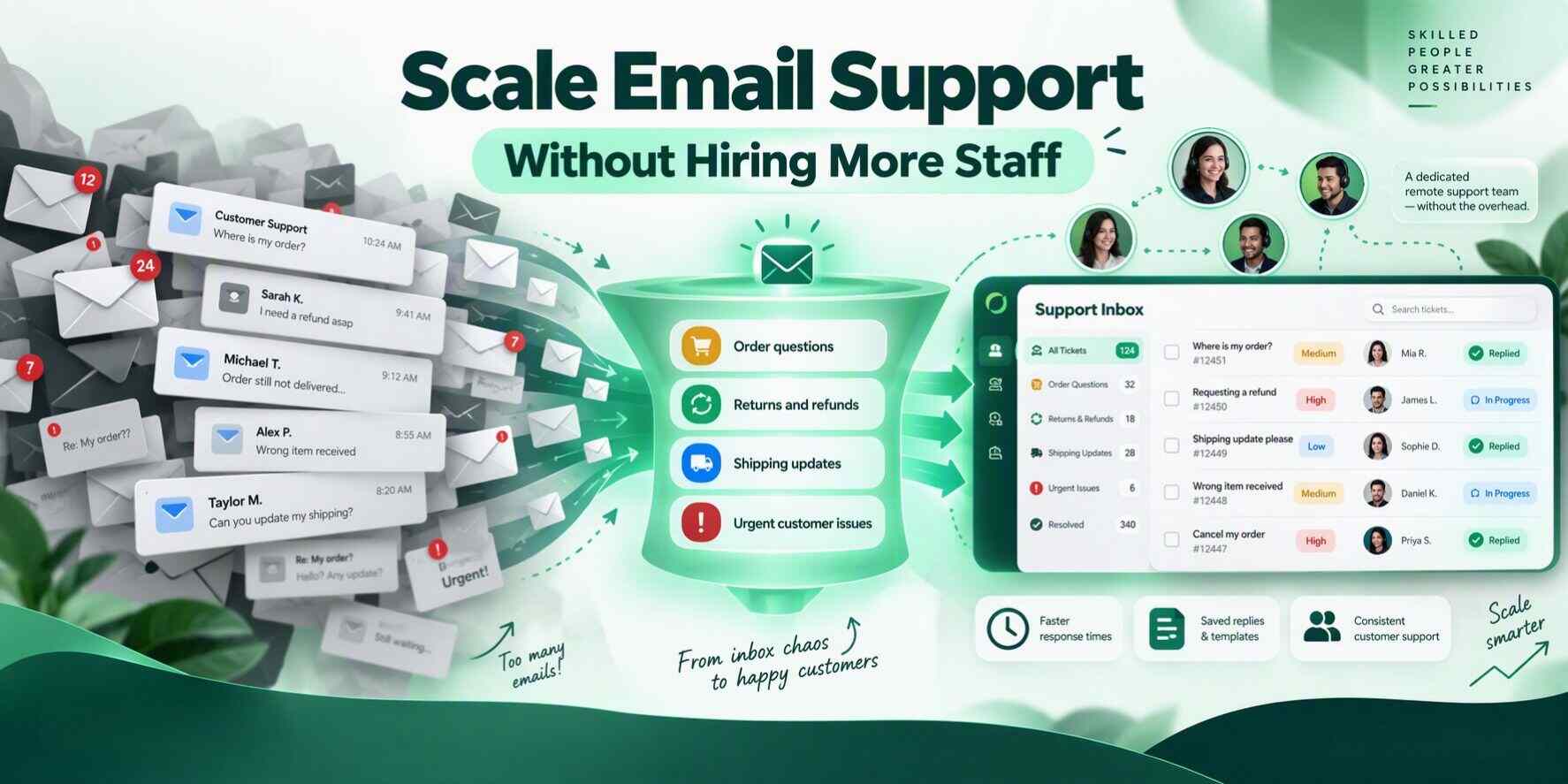
The short answer: scaling your email support without taking on more in-house staff means sorting your tickets by type, writing down the answers to every repeat question, and using a shared helpdesk with a library of saved replies — so you can hand the leftovers to a dedicated outsourced team following the same process you laid out.
Why email support breaks before everything else
Anyone can answer an inbox, so nobody thinks about how it's run. That's the trap. There's no queue and no owner, and you can't tell who replied to what. Two people answer the same customer. Or nobody does, because each assumed the other had it.
Slow replies hurt first. SuperOffice surveyed 1,000 companies and found the average email first response took 12 hours and 10 minutes, with only 36% replying inside four hours. Your customers aren't grading you against that average, though. They're comparing you to the last shop that wrote back in ten minutes.
The obvious fix is to hire, and it's usually the slow one. You recruit, train, buy a laptop, and set up payroll, and the new person hasn't touched a ticket yet. Then the busy season ends and the salary doesn't.
Fix the inbox before you add people
One commenter in that thread said to categorise your last 100 tickets before deciding anything. Good call. It takes an afternoon and might save you a hire.
Sort your last 100 emails by type
Say you sell candles online. You'll probably find questions about scents and shipping, "where's my order" messages, and a small pile of real problems like a cracked jar. Only that last pile needs a skilled person each time. The first two repeat almost word for word, so put the answers on a product page or help centre, and a good chunk of those emails never get sent.
Write the answers down once
Give every repeat question a saved reply and a short written procedure. Rough is fine. Several people in the thread said to document before hiring, since the first few weeks of real tickets will show what's missing anyway. Decent email customer service really comes down to this: the dull questions get a settled answer, and your people save their brainpower for the awkward ones.
Move to a shared inbox or help desk
Shared mailboxes get messy in double-quick time once a few team members start working them, but a helpdesk keeps each email tidy with an owner, a status, and a timestamp, so you can see exactly where things stall. Tag tickets by category as they come in — don't try to do it afterwards. One commenter noted that this is how you spot someone drifting off-script.
Keep email customer support fast and consistent as volume grows
Consistency comes from rules. Heroics don't last. First, set a target for how fast you want to get back to people — maybe 4 hours for day-to-day stuff and 1 hour if it's urgent. Send an auto-acknowledgement to let people know their message landed, but don't count it as a proper response, because the customer won't be satisfied with that.
Then check the work. Read five or so replies per agent every week and compare them to your written answers, instead of going on a vague sense of tone. That habit is what keeps things steady when new people, or a partner team, join in.
Hours and language trip people up too. A US store that shuts at 6 p.m. lets overnight emails pile up while a team somewhere else is mid-shift. And if you sell in Quebec, expect French. In the UAE, plenty of customers write in Arabic.
Inbox outgrowing your team?
Tell us your ticket volume and the hours you need covered. We'll send a pre-vetted email support agent who follows your process — profiles in 48 hours.
When outsourced email support makes sense
Outsourcing isn't step one. The forum advice agrees: tidy the ticket pile first. After that, you're probably ready if:
- Email swallows several hours of your day, every day.
- Replies slip past your targets in busy weeks.
- Customers write when you're offline.
- You'd rather not run hiring, training, and payroll for one more role.
Peak seasons make it obvious:
- USA: Black Friday and Cyber Monday.
- UK: January sales and Boxing Day returns.
- UAE: Ramadan and White Friday.
- Canada: Boxing Week.
- Australia: Boxing Day.
A fixed team ends up too big for ten months and too small for two. Outsourced email support can stretch and shrink with you.
Before you sign with anyone, ask these questions:
- Who hires and trains the agents?
- Do they work only for you?
- How is quality checked?
- What happens when someone quits?
- Where does your customer data live?
Some providers get vague on that last one.
Meet The Remote Staff: a managed alternative to hiring in-house
The Remote Staff builds dedicated offshore teams for companies in the UAE, USA, UK, Canada, and Australia. They find the right person, employ them, sort the payroll and compliance, and manage how well they do, while they work exclusively for you. Customer support agents are one of the roles on offer. Their site lists it at about seven days to hire, from AED 4,200 a month.
If you're stuck between "one part-timer can't cope" and "I can't justify a whole department," that middle option is worth a look.
The Remote Staff vs hiring in-house vs a staffing agency
| Hiring in-house | Traditional staffing agency | The Remote Staff | |
|---|---|---|---|
| Time to first shortlist | You source and screen | 1 to 3 weeks | 48 hours |
| Who employs the agent | You | You, after placement | The Remote Staff |
| Payroll, compliance, devices | Yours | Not included | Handled for you |
| Performance management | You | Ends at placement | Monthly 1:1s and daily reports |
| If it doesn't work out | New search, new cost | New fee, new search | Free replacement |
| Cost model | Salary plus benefits, tax and equipment | 15 to 25% of annual salary, one-off | One monthly fee per person |
Agency and Remote Staff figures come from the company's own comparison, so check current terms with them.
Why choose The Remote Staff for email support
They promise pre-vetted profiles within 48 hours, with someone up and running in as little as one to two weeks — where sourcing and screening on your own can take up to 10 weeks. Candidates go through proctored assessments, and you can add a paid trial task. For email work that's a smart move, since writing quality is easy to test.
They also keep managing people after the hire. Account managers hold monthly one-on-ones with each employee, and you get daily activity reports and time tracking, so you can see the inbox is actually moving. If a hire doesn't work out, replacement is free.
Price is the other draw. Starting rates per dedicated staff member each month are:
- UAE: AED 1,799
- USA: $1,499
- UK: £799
- Canada: CA$1,899
- Australia: A$2,499
They claim savings of up to 70% compared with hiring locally. Final rates depend on role, seniority, and hours, so ask for a proper quote.
My advice for any provider: start small. Take one agent, compare the first month of replies against your written answers, and only then add people.
Frequently asked questions
Sort tickets into categories and write a saved reply for each repeat question. Move to a shared help desk so every email has an owner, set response targets per category, and review a few replies each week. Speed and accuracy tend to rise together.
Across industries, it's around 12 hours, according to SuperOffice. Top-performing teams aim for under four hours. Four hours is a sensible goal for general questions.
Triage first. Tag each email by type and urgency, answer repeat questions with saved replies, and publish common answers on your site. Send tricky cases to experienced agents. If volume stays high after that, add an outsourced team rather than a bigger inbox.
Good email customer support means clear, quick, helpful replies that make customers feel heard. Answer the main question first, use simple language, keep one person responsible for each conversation, and reply within the promised time. Make sure the problem is fully resolved before closing, and review sample replies regularly to keep answers accurate and consistent.
Use auto-acknowledgements, saved replies, and priority tags. Publish a help centre so fewer emails arrive at all. Cover other time zones with a partner team, and track first-response time by category so you can see where delays hide.
You start faster than hiring, pay less per agent, handle busy seasons, extend your hours, and skip HR and payroll work. The risk is quality control. Hand over scripts and FAQs upfront, as forum users suggest, and review samples regularly.
Conclusion
Scaling email support doesn't mean hiring another full-time agent and taking on more HR work. Start with the basics: sort your tickets by type, write down the answers to repeat questions, and set clear response targets. Once the routine volume is documented, outsourced email support lets you hand it to a dedicated team that follows your process, without the cost and delay of building one in-house.
If your inbox is already slipping past your response targets, The Remote Staff can help. They hire, employ, and manage a dedicated email customer support agent who works only for you. Pre-vetted profiles arrive within 48 hours, interviews are free, and you pay only when you hire.
Hand off the inbox, keep the quality
We'll hire, employ, and manage a dedicated email support agent who follows your saved replies and targets. Interviews are free.